Material Experiments in Affixed Movement: Cross Talk at Nguyen Art Gallery
There is an invitation in the works curated in the group show titled Cross Talk at Nguyen Wahed Gallery. In the silence of my own movement from one piece to another, I can hear the work in a chorus, full of query; how can a medium exist on its own when interdisciplinary is at play? How can research be translated into a praxis? How does the viewer become an active participant in this conversation itself and not just an enforced invisible space?
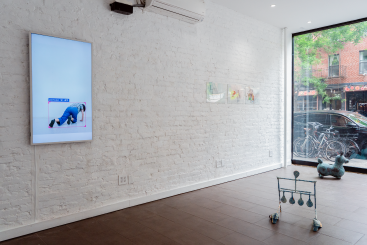
Art is fundamentally an arbitrary location which churns, embraces, interrogates, and innovates image. In Cross Talk, an image is generated as a form of language that does not entirely delve to please comprehension. I found this evident in the work of Sol Kim’s Metamorphosis, a single channel video which used the artist’s body as a discourse for movement if it was caged, inherently in a state of claustrophobia, and affixed to an uncomfortably frozen condition. Using an object detection AI, Kim utilized 30,000 images, creating a disjointed dance with a seemingly stop motion effect during her 11 minute long video install. In it, her body is boxed. A red frame encompasses her. Sometimes she is on the floor, sometimes she is suspended in a jump, sometimes it's all and everything in rhythmic repetition. Apart from the size of the box and her affixed movement, language follows; with every changing frame, the caption accompanying it says: person 1.2%, person 34.3%, person 78.1% and so on… until it reaches a close finality of 99% before we are looped back to the initial 0, from where it begins again.
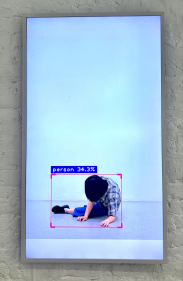
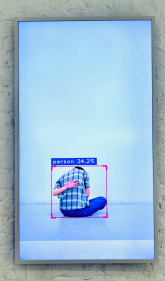
The contrast of claustrophobic boxing generated with AI, which detects a living human body as an object, enforces the viewer to question the identity of the artist as a person. It is an eerie notion to discover that what can be humanized can also be objectified. In a landscape where bodies of marginalia are often seen as collateral numbers to systems designed for the oppressor, one abides to a survival that asks for compliance.
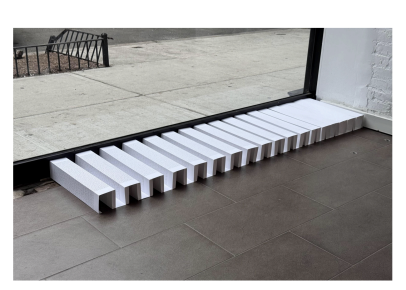
But the push for defiance arises as well at Cross Talk. As as a form of erasure, explicitly researched code mimicking a form of numerical linguistics and structured into a multifolded sculpture embracing its own form of movement, Jingyi Ling’s Inequation I is a piece which entranced, bringing transdisciplinary to the discourse of mediums prevailing as a reckoning of revolt. Ling uses a collapsible and foldable cardstock paper to build a sculpture with rhythmic folds. The space between each plane gradually decreases to conjoin towards a consistent surface. There is a musicality in the piece which does not hold sound– it comes through in the consistency of the ridges, its ruptures and collapses, reminding one of a heart monitor plugged to a humanized body to witness one’s EKG. This liveliness embraces the numerical code printed on the sculpture; a deceptive arbitrary which centers modular channel-section units and holds ASCII encoding. Furthermore, Inequation I asks itself to be moved from its awkward placement against the wall while lying flat on the floor by the elements of human disruption such as the wind from the gallery’s door or the stomping footsteps of feet. The delicacy of paper and the anticipation of its disaster reminds one of death, which humanizes the object itself.
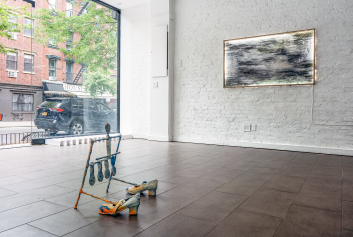
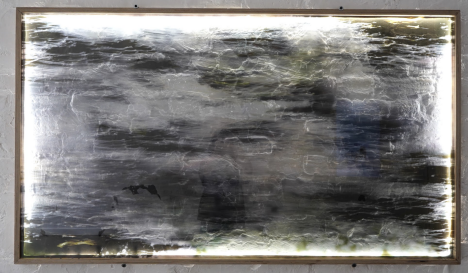
Dylan Li, in contrast, worked against the conventional idea of the human body and its objectification by bringing the discourse of transdisciplinary face to face with nature and its allocated location. Li focused on transparency; bringing a negative space to function as an active one. Aerial View grew from a 22 second video recording from the window of an airplane departing the outskirts of Chongqing. He builds a surface out of the frames of the video towards a single photograph, embracing another movement affixed to a frozen state. Printed onto transparency, the photograph had the ability to hold the characteristics of the location it finds itself in. In this case, Nguyen Waheed’s walls were bricked, white, and textured… and in New York City. It gave a multifaceted discourse of belonging to the transdisciplinary work Li envisioned, creating a crossroad of grief and dislocation between China and America, his two homes and settlements.
Cross Talk held a strong conversation in movement and materiality. It further highlighted and complimented the pieces curated, utilizing the gallery space in an inviting way for the viewer to move, lean, slouch, crouch, and partake in their own movement. The works of Ana González, Cacie Rosario Jackson, Sol Kim, Dylan Li, Jingyi Ling, Noa Mori Machover and Shay Myerson all held a strong core of individuality yet collectiveness, bringing forward a strong camaraderie in what it can mean to innovate towards a transdisciplinary existence.